
Introduction to Photoionization

A Photo-Ionization Detector (PID) measures real-time concentrations of organic and inorganic vapors in low levels from parts-per-billion (ppb) up to 10,000 parts-per-million (ppm). A PID is a very sensitive instrument used in a wide variety of applications such as:

  • Hazardous waste sites
  • Clean-up of spills
  • Protecting workers from toxic vapors
  • Refineries
  • Leak detection for compliance
  • Pulp and paper plants
  • Hazardous materials response
  • Terrorist chemical attacks

How Does a PID Work?

A PID uses an ultraviolet (UV) lamp to ionize molecules, causing them to release an electron and form a positive ion. This will occur when the Ionization Potential (IP) of the molecule is less than the electron volt (eV) output of the UV lamp (i.e., 10.6eV, 11.7eV, or 11.8eV). Ions formed in the air are driven in one direction by a bias electrode and accumulated at a collecting electrode. The ion current is then amplified and converted to a digital meter readout in parts-per-million (ppm). The most common UV lamps used in field work are 10.6eV, 11.7eV, and 11.8eV. The useful lifespan of the 10.6EV is about 3,000 hours, the 11.7eV is about 200 hours, and the 11.8eV is about 500 hours. Of course, these lifespans are all dependent on how carefully the lamps are used and maintained.

Photo-Ionization Detector (PID)
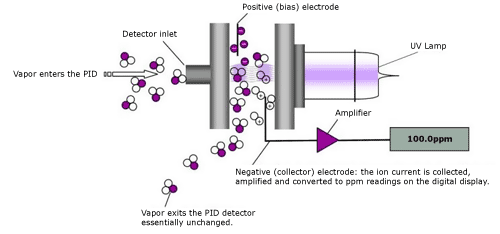
Photo-Ionization Detector (PID) - Vapor enters the PID, Detector Inlet, Positive (bias) electrode, UV Lamp, Vapor exits the PID detector essentially unchanged, Amplifier, Negative (collector) electrode: the ion current is collected, amplified and converted to ppm readings on the digital display.

Browse All Rental Categories

105 Categories, 217 Models

Our Most Popular Rental Categories

Browse By Manufacturer

25 Manufacturers, 183 Models

Our Most Popular Sales Models

RKI Eagle 2

Multiple Gas Monitor

RKI Insruments Eagle 2 Multiple Gas Monitor (6 Gas including PID)

RKI’s Eagle 2 is an advanced portable gas detector capable of monitoring up to six sensors simultaneously including a PID. 16 different sensors are available providing for hundreds of configuration possibilities.

Landtec GEM2000

Landfill Gas Analyzer

CES Landtec GEM2000 Handheld CO2/CH4/LEL/O2/Pressure Monitor

A versatile landfill gas analyzer, the GEM2000 is capable of measuring the composition of both gas extraction systems and gas migration probes. In addition to gas levels, they also measure pressure and calculate flow.

Levelogger Edge

Water Level Datalogger

Solinst Levelogger Edge Water Level Datalogger

Advanced and durable, the Levelogger Edge is the latest water level datalogger from Solinst. An all new sensor design manages to achieve excellent accuracy while being more robust then previous models and remaining economical.

RAE MiniRAE 3000

Handheld PID Monitor

RAE Systems MiniRAE 3000 Handheld PID Monitor

RAE Systems PIDs are known worldwide for their incredible reliability, accuracy, and features. The MiniRAE 3000 is the latest flagship model featuring the widest range of any handheld PID available and built in correction factors for over 200 compounds.

PetroFLAG

Hydrocarbon in Soil Analyzer

Dexsil PetroFLAG TPH (Total Petroleum Hydrocarbon) in Soil Analyzer

The PetroFLAG provides economical on site analysis of the total hydrocarbon content of soil samples or to quantify levels of known contaminants. These easy to use analyzers are not only cost effective, but easy to use, environmentally safe, and accurate.

Professional Plus

Water Quality Meter

YSI Professional Plus Handheld Multiparameter Water Quality Meter

The Professional Plus is the world's most versatile water quality meter. Interchangeable cables and multiple accessories allow a single instrument to be quickly changed for use in the field as a handheld meter, for low flow sampling, or in the laboratory.

Thermo TVA1000B

Flame Ionization Detector

Thermo Scientific TVA1000B PID/FID Combination Detector

Not only is the TVA1000 our most popular flame ionization detector, it is also the most versatile due to its ability to be configured with a PID detector as well providing the benefits of both sensor technologies simultaneously.