Introduction to Gas Detection
Gas detectors can be found in all walks of life, from food processing plants to parking garages, from airplanes to casinos. Any place that can have a potential lack of oxygen or presence of a toxic gas needs a gas detector present to monitor the safety of people. Some common uses during field projects are: confined space entry, well drilling, soil screening, area monitoring, worker safety, indoor air quality, and leak detection. Gas detectors have a variety designs; pager size units, handheld datalogging units, Stand alone area monitors, and wall mount fixed systems.
Here are some gas detection basics:
- 1ppm is one part in 1,000,000 parts. Generally ppm (parts per million) is the lowest unit of measurement 10,000ppm = 1% by Volume
- LEL is the next unit of measurement. It is a percentage of the explosive %(vol) level of a compound.
- 100% LEL is the lowest concentration at which a flammable substance can produce a fire or explosion when ignited.
- UEL (Upper Explosive Limit) is the maximum concentration of gas in air that will burn.
- Each compound (gas) has a different LEL, or the point at which the compound will burn or become explosive.
- Most flammable compounds become explosive at less than 5%(vol).
- Each gas has a different LEL and UEL.
- %Gas is the highest unit of measurement, which is the amount of pure gas.
How Do Gas Detection Sensors Work?
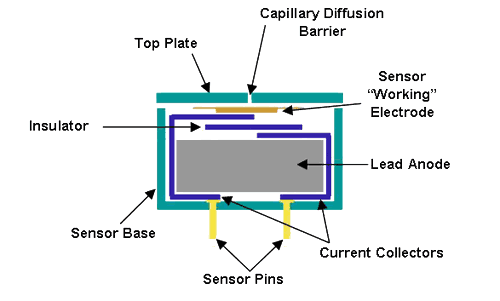
The Oxygen Sensor is an electochemical sensor. Any gas which can be oxidized or reduced electrochemically can be detected by means of a fuel based electrochemical sensor. The consumption of oxygen produces a current (µA) which is linearly proportional to the concentration of gas in air. Since the oxygen sensor is constantly exposed to oxygen, the normal life of the sensor is between 1-2years.
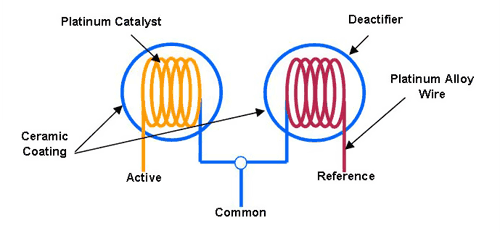
The Combustible Sensor consists of two coils of fine platinum wire each embedded in a bead of alumina, connected electrically in a bridge circuit. One of the beads is impregnated with a special catalyst which promotes oxidation and the other is treated to inhibit oxidation. Current is passed through the coils so that they reach a temperature at which oxidation of a gas readily occurs at the catalyzed bead (about 500°C). This raises the temperature further which increases the resistance of the platinum coil in the catalyzed bead, leading to an imbalance of the bridge. This output change is linear, for most gases, up to and beyond 100% LEL and response time is only a few seconds to detect alarm levels (typically 20% LEL).
The Toxic Sensors are also electrochemical sensors which operate by the same basic principles as the oxygen sensor. Electrochemical sensors consume minute amounts of gas, the absorption of gas and electric output being controlled by a “diffusion barrier”.
Electrochemical Sensor
Combustibles Sensor